

In modern industrial automation, PROFINET cables form the reliable communication backbone connecting controllers, I/O devices, and field instruments. While selecting the right cable is crucial, testing its performance and reliability is equally important.
As industries continue adopting automation to boost efficiency and productivity, the role of these cables becomes even more significant. Choosing the right PROFINET cable is not just about compatibility; it is essential to consider factors such as cable length, shielding, and environmental conditions to ensure optimal performance. A well-selected cable can improve data transmission speeds and reduce latency, contributing to an overall more responsive and efficient system.
However, the importance of selecting the proper PROFINET cable goes beyond choosing the right product; rigorous testing is essential to validate its performance and reliability in real-world applications. Cable failures may cause major operational challenges, including unexpected downtime and intermittent communication errors, ultimately resulting in costly repairs that disrupt productivity and impact the bottom line.
1. Why Testing PROFINET Cables Matters
PROFINET is a widely adopted industrial Ethernet standard that enables real-time communication between devices in manufacturing environments. As organizations increasingly rely on this technology to enhance connectivity and streamline processes, the importance of ensuring the quality and performance of PROFINET cables cannot be overstated. Testing these cables is not just a preventive measure—it is a critical step in safeguarding the entire network infrastructure.
Testing PROFINET cables ensures four major benefits:
-
Consistent data transmission by preventing packet loss and communication failures.
-
Network reliability, reducing unexpected downtime.
-
Standards compliance, confirming adherence to IEC 61158 and PROFINET requirements.
-
Cost savings by detecting faults before they escalate into system failures.
2. Key Performance Parameters to Test
When testing PROFINET cables, the following factors should be evaluated:
-
Signal integrity – ensures clean, distortion-free data transmission.
-
Impedance matching – PROFINET typically requires 100Ω Cat5e/Cat6 cabling.
-
Crosstalk (NEXT and FEXT) – prevents interference between cable pairs.
-
Attenuation – measures signal loss over cable length.
-
Return loss – evaluates reflections caused by poor terminations.
-
Shielding effectiveness – critical in noisy industrial environments.
-
Physical damage – cuts, bends, or kinks can degrade performance.
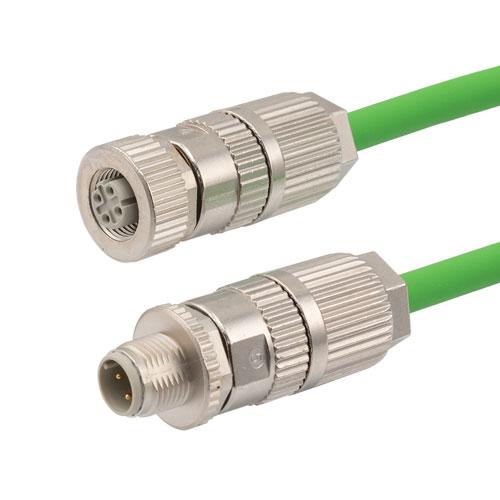
Example cable:
PROFINET type B/C industrial Cat5e Ethernet cable, IP67-rated D-coded M12 male-to-female, SF/UTP double-shielded 22AWG stranded conductors, high-flex outdoor industrial grade, PLTC rated, green TPE jacket.
3. Methods for Testing PROFINET Cables
1) Visual Inspection
A thorough visual inspection is the first step in assessing cable integrity. Check all connectors for signs of damage, corrosion, or bent pins. Examine the cable length for physical stress, tight bends, or exposed shielding. In general, maintain a minimum bend radius equal to eight times the cable diameter to prevent internal conductor damage.
2) Continuity Testing
Continuity testing ensures all eight conductors are correctly connected end-to-end. This identifies open circuits, shorts, or crossed wires that can disrupt communication. A simple cable tester or multimeter can verify basic continuity during installation or maintenance checks.
3) Wiremap Testing
Wiremap testing verifies correct pin assignments according to TIA-568A or TIA-568B standards. It identifies split pairs that may not appear in a basic continuity test but can significantly impair signal quality. Validating the wiring layout helps maintain consistent performance and standards compliance.
4) Signal Integrity Testing
Signal integrity testing evaluates a cable’s ability to transmit data without degradation by measuring attenuation, crosstalk, and impedance. Tools such as the Fluke Networks DSX CableAnalyzer are typically used to certify cables for compliance with Ethernet and PROFINET performance standards.
5) Shielding & Grounding Verification
This test confirms that shielding is continuous throughout the cable and connectors, and identifies grounding issues that may increase susceptibility to EMI. Proper shielding and grounding are essential in noisy industrial environments.
6) Bit Error Rate Testing (BERT)
BERT measures actual data transmission errors under load. By assessing bit error rates during operation, this test provides a realistic evaluation of cable performance in real-world usage—critical for networks requiring high reliability and low latency.
7) Environmental Stress Testing
Environmental testing exposes cables to extreme temperatures, vibration, moisture, and other harsh conditions to verify durability in industrial or outdoor environments. Outdoor-rated PROFINET cables often use PUR or PE jackets to resist UV radiation and chemical exposure.
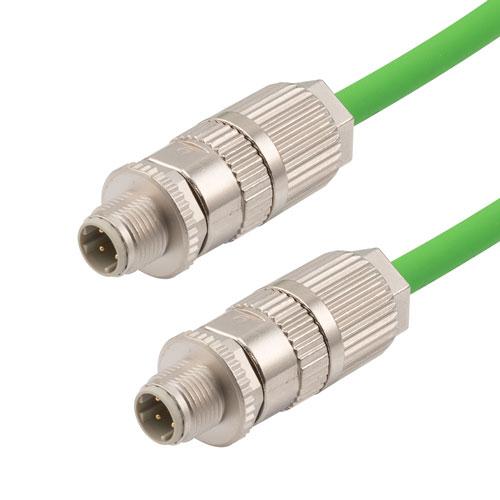
Example cable:
PROFINET type B/C industrial Cat5e Ethernet cable, IP67-rated D-coded M12 male-to-male, SF/UTP double-shielded 22AWG stranded conductors, high-flex outdoor grade, PLTC rated, green TPE jacket.
4. Recommended Testing Tools
Different levels of testing equipment ensure PROFINET cable integrity and compliance:
-
Basic testers – For quick continuity and wiremap checks.
-
Advanced certification testers (e.g., Fluke, Softing) – Verify full compliance with PROFINET and Ethernet standards by measuring attenuation, crosstalk, impedance, and more.
-
Network analyzers – Diagnose real-time network performance, monitor communication quality, and detect operational issues.
5. Tips for Reliable Testing
-
Always test before installation to avoid costly downtime and rework.
-
Label all tested cables and store certification reports for traceability during audits or maintenance.
-
Use shielded connectors in high-EMI areas to maintain signal integrity.
-
Replace any cable with signal loss exceeding standard limits (e.g., >3 dB) to ensure long-term network reliability.
6. Common Testing Mistakes to Avoid
Common mistakes that compromise testing accuracy include:
-
Skipping shielding verification in high-EMI environments.
-
Relying on consumer-grade testers rather than PROFINET-certified equipment.
-
Ignoring manufacturer installation guidelines.
-
Failing to test cables under actual load, preventing detection of performance issues that occur only during operation.
7. Long-Term Reliability Recommendations
-
Use Cat6 or higher-rated PROFINET cables for all new installations.
-
Establish a preventive maintenance plan with periodic cable testing to detect early degradation.
-
Choose LSZH or PUR-jacketed cables for harsh or demanding environments.
-
Store and handle cables properly, avoiding excessive bending or mechanical stress to prevent micro-cracks that degrade electrical performance over time.
8. Frequently Asked Questions About PROFINET Cable Testing
Q1: How often should PROFINET cables be tested?
A: Test during installation and every 12–18 months as part of preventive maintenance.
Q2: Can standard Ethernet testers be used for PROFINET cables?
A: They can perform basic tests, but PROFINET-certified testers are recommended for full reliability.
Q3: What is the maximum supported cable length for PROFINET?
A: 100 meters per segment for copper cables; fiber-optic PROFINET can extend much farther.
Q4: How can I verify that shielding is effective?
A: By performing shielding continuity and grounding tests.
Q5: Is testing outdoor PROFINET cables different?
A: Yes. In addition to electrical tests, UV resistance, temperature endurance, and moisture protection are also evaluated.
Post time: Dec-11-2025