

Against the backdrop of rapid development in network infrastructure, the telecommunications industry is increasingly facing a critical growth bottleneck. One of the core technologies in optical communications — Wavelength Division Multiplexing (WDM) — has become a key solution for overcoming these physical limitations.
If optical fiber is compared to a highway, traditional single-wavelength communication is like a single vehicle occupying the entire road. WDM technology essentially divides this physical pathway into multiple non-interfering “virtual lanes” (different optical wavelengths), allowing multiple data signals to be transmitted simultaneously through the same fiber. The core hardware enabling this technology is the passive DWDM (Dense Wavelength Division Multiplexing) filter. This article provides a brief analysis of this technology.
I. Core Principles and Advantages of Passive Filters
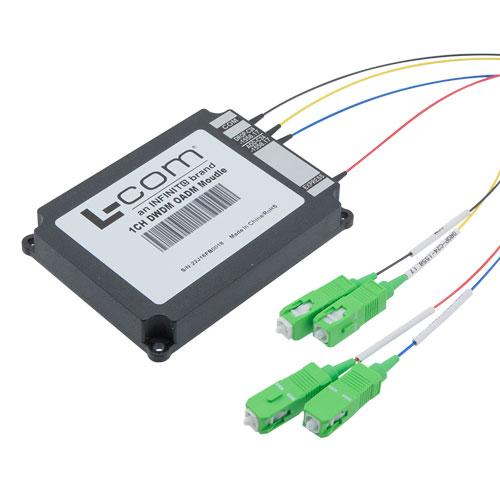
Passive DWDM, OSP Ring OADM, 1 Channel, 100 GHz Spacing, Channel 48, 900um 1m Fiber, SC/APC Connector
The term “passive” means that the device does not require any external power supply. Instead, it relies entirely on precision optical thin-film coatings or grating structures to accurately separate (demultiplex) or combine (multiplex) optical signals of different wavelengths.
This purely physical optical characteristic provides exceptional stability and reliability, making the device highly resistant to electromagnetic interference. As a result, it is particularly suitable for long-term operation in complex telecom equipment rooms or harsh outdoor environments.
Within optical network architectures, passive DWDM filters act as “traffic controllers.” They strictly follow International Telecommunication Union (ITU-T) standards, dividing the low-loss optical transmission window into dozens or even hundreds of independent communication channels with extremely narrow wavelength spacing.
This means that a single optical fiber, originally capable of carrying only one signal, can instantly expand its transmission capacity by dozens of times, dramatically improving spectral efficiency.
II. Typical Application Scenarios and Value
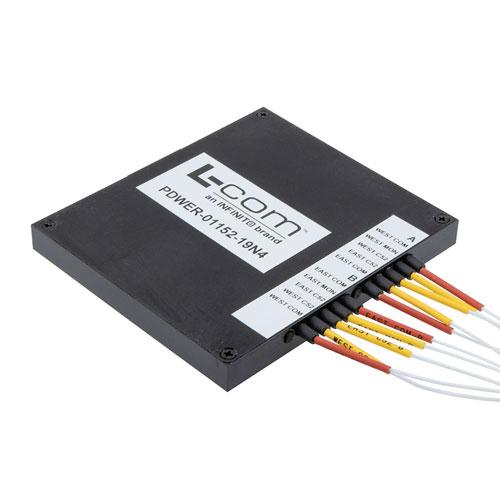
Passive DWDM, OSP Ring OADM, 1 Channel, 100 GHz Spacing, Ch52, Monitor (1%), 900um 1m Fiber, Without Connector
These passive filters are typically designed with standardized packaging structures, such as LGX cassette modules or 19-inch rack-mount cards, and equipped with high-precision fiber optic connectors for seamless integration into existing single-mode fiber networks. Their key application values include:
Metropolitan Transmission and Backbone Network Expansion
Without adding new physical fiber cables, WDM technology can rapidly increase the transmission bandwidth of metropolitan area networks and regional backbone networks, meeting the massive data throughput demands of services such as high-definition video streaming and cloud computing.
Outside Plant (OSP) and Access Networks
Thanks to their passive and maintenance-free characteristics, these devices are widely deployed in outdoor optical distribution networks, effectively reducing long-term operational and maintenance costs for telecom operators.
Data Center Interconnection
Within data centers or between multiple data centers, passive filters enable highly efficient routing of multiple optical signals with extremely low insertion loss, ensuring fast and stable data transmission.
Post time: May-14-2026